
History
History of Toronto's
AIDS Memorial
How it began
The AIDS Memorial currently standing in Barbara Hall Park is tied to a history of community organizing and care. Created by the AIDS Memorial Committee, the temporary and permanent memorials held in Barbara Hall Park centred on the real people fighting against the epidemic and reflected upon the incommensurable loss faced as a result, listing the names of those who had lost their lives instead of their frequent representations in statistics.
The AIDS Memorial Committee was founded in 1987, spearheaded by activist Michael Lynch. The committee’s constitution states that its goal is to “create, maintain, [and] manage any temporary or permanent AIDS Memorial created by the organization on behalf of the community” (F0040-01-001). The constitution also states that membership is encouraged from anyone who is interested in joining, and the responsibilities of the members are to participate in meetings, planning, and development of the various memorials. The committee consisted of Michael Lynch, a poet, journalist, and professor at the University of Toronto, as well as a gay liberation activist and organizers, a Toronto City Councillor, and an architect. The committee was volunteer run and funded through donations and occasional grants.
Timeline
In 1987, the AIDS Memorial Committee was founded. While the first memorial would not be carried out until 1988, the Committee began planning and organizing for future memorials upon their foundation.
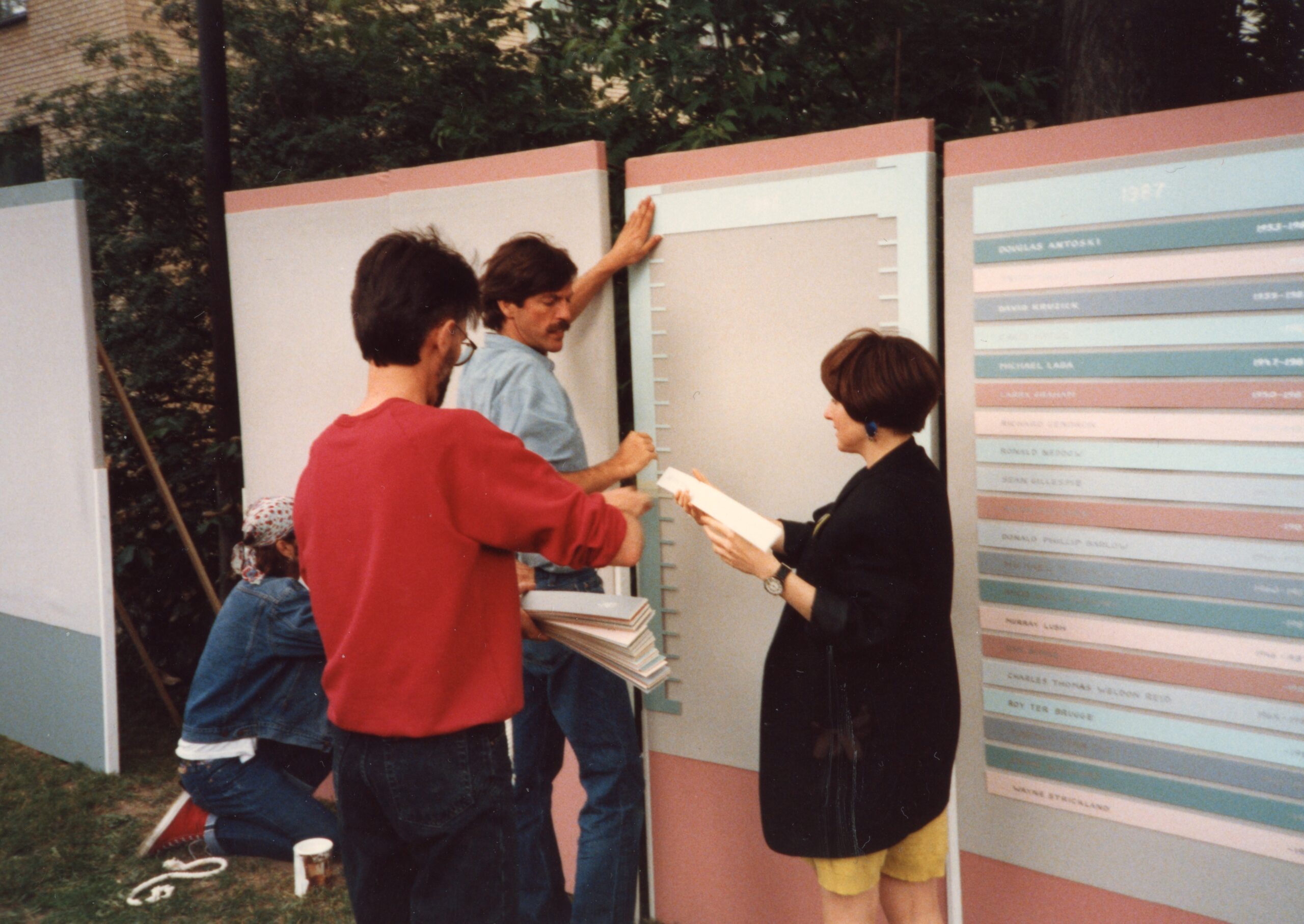
First temporary memorial erected on Toronto Lesbian and Gay Pride Day. The first memorial consisted of pillars listing the names of those who had passed away from AIDS for each year.
The second temporary memorial was held on Toronto Lesbian and Gay Pride Day. The committee also began planning for a permanent memorial this year, thinking towards goals and requirements necessary for its development.
In late 1990, the first design competition for the permanent memorial launched. While the exhibition displayed 71 proposals, they were unable to call a winner, announcing to entrants that the competition reached a stalemate on November 28th, 1990.
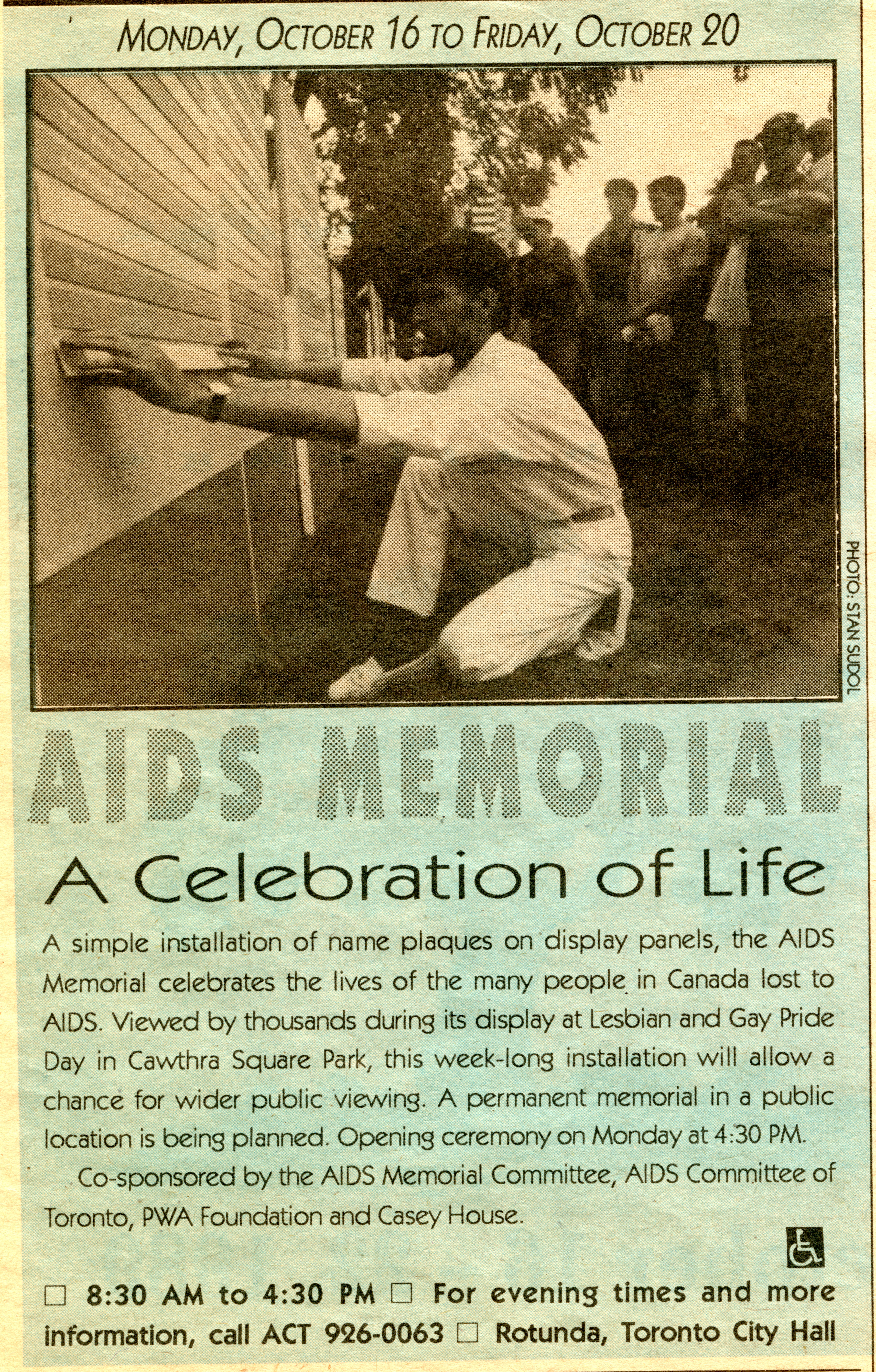
16 October 1990: a temporary memorial was displayed at City Hall with the participation of Councillor Jack Layton for AIDS Awareness Week.
25 April 1991: Due date with 68 registrants
11 May 1991: Shortlist
June 1991: Winning design announced
October 1991: Exhibition of winning design and runner ups
The second design competition was held in April of 1991, with another 70 entrants. The winner of the competition was announced in June, 1991, with architect Patrick Fahn winning the competition. An additional celebration was held to exhibit the design submissions in October, 1991.
25 April 1991: Due date with 68 registrants
11 May 1991: Shortlist
June 1991: Winning design announced
October 1991: Exhibition of winning design and runner ups
The second design competition was held in April of 1991, with another 70 entrants. The winner of the competition was announced in June, 1991, with architect Patrick Fahn winning the competition. An additional celebration was held to exhibit the design submissions in October, 1991.
29 June 1991: Toronto Gay Men’s Chorus presents “Sing,” a champagne gala celebration with Vancouver Men’s Chorus and Ottawa Women’s and Men’s choruses and Timberline as a fundraising event for the aids memorial committee and toronto gay men’s chorus.
The groundbreaking for construction of the permanent memorial was held in October, 1992, which would continue for under a year.
Five years after the first temporary memorial, the construction of the permanent memorial was completed in June, 1993, with the unveiling ceremony being held on June 19th, 1993.
To commemorate those unnamed by the memorial, the committee held a competition for the Universal Remembrance Plaque, selecting Shoshanna J. Addley’s poem “Circle of Stones” as the winner.
June 1995: The Universal Remembrance Plaque is added to the first pillar of the permanent memorial, featuring Shoshanna J. Addley’s “Circle of Stones,” as well as Michael Lynch’s poem “Cry” to commemorate the founder of the committee who had passed away prior to the permanent memorial’s unveiling.

The first temporary memorial was held on June 27th, 1988, Lesbian and Gay Pride Day, in Cawthra Square Park, now Barbara Hall Park, located beside the 519. The Memorial listed roughly 200 names of those who had passed away due to AIDS submitted to the committee through letters or name nomination slips. Operating in close proximity to The 519, Cawthra Square Park became a stable location for the memorials to be held, and was the site for the following 1989 temporary memorial. In 1990, the focus of the committee was set on developing a permanent memorial to be held in Barbara Hall Park, but another temporary memorial was held in the City Hall for AIDS Awareness Day with the support of then Councillor Jack Layton.
The memorials were funded primarily by community donations and fundraising events. These events included a New Year’s Eve party at the Sears Warehouse, Sing, a celebration with the Toronto Gay Men’s Chorus, Vancouver Men’s Chorus, Ottawa Women’s and Men’s Choruses, and Timberline, and Steers, Beers and Queers at the 519 Community Centre. Additionally, advertisements in Xtra Magazine called for donations for the memorials to continue. These advertisements were present with the first memorial in 1988, but increased in frequency in preparation for the permanent memorial.

After the 1989 temporary memorial, the committee moved toward creating a permanent memorial. A letter from Michael Lynch to the Committee outlined a strategy toward establishing a permanent memorial, stating that building community support and establishing a board was essential in order to begin organizing for the permanent memorial. In this letter, it also states that the memorial’s use of names was of particular importance, and while anonymous memorials will be considered, the core part of the experience of visiting the memorial includes reading the names of those who have passed. The Design Competition and development of the permanent memorial was sponsored by The City of Toronto’s Public Arts Commission and Parks and Recreation Department.
To plan for the permanent memorial, the first design competition launched for community members to submit proposed memorial designs in late 1990. With a budget of $75,000, proposals required certain elements; a plan, including the location of the design; the scale of the proposal, including people for scale; and proposed construction materials, colours, and construction details. The design competition brief outlined that proposals must “project a strong public image as the AIDS memorial, and must be identified with all those affected with AIDS… acknowledge the need for private meditation and remembering… be able to function as a focus for public gatherings.. [and] take its place in the everyday life of this multiple-use park” (F0040-05-006, p. 4). Additionally, the brief requires the memorial to “recognize the particularities of this epidemic and those most affected by it.”

Despite the 1990 design competition garnering numerous submissions and the exhibition displaying 71 proposals, the competition reached a stalemate in November, 1990, primarily due to a majority of the proposals being over budget. As a result, a second Design Competition for the permanent memorial was launched in 1991. Both the 1990 and 1991 competitions were made of the same jury, being founding committee member Michael Lynch; artist and director Lynne Fernie; curator John Klintsworth; architect Bruce Kuwabara; Executive Director of the 519 and Toronto City Councillor Kyle Rae; designer Virginia Wright; and writer, teacher, and landscape designer Alex Wilson. In addition, the City of Toronto had three Technical Advisors reviewing applications.
The design competition had a deadline of 5 pm on April 25, 1991, and garnered sixty-eight submissions, including some from the first competition. After their review from the Technical Review Committee and jury, five were disqualified for not adhering to competition rules, and three finalists were selected on April 27th. The winning design was selected on May 11th, and later announced in June. There were two runner-ups and jury merit acknowledgements. The jury merit acknowledgements were Rick Andrighetti; Gail Campell, Cheryl Krismer and Lloyd Partridge; Beverly Gray Friesen; and Michael Taylor. First runner-up was Brian Smith and David Stavropol, and second runner-up was Gabor Mezei.
Out of the sixty-eight applicants, the winner of the design competition was announced to be architect Patrick Fahn. The Committee, the 519, Patrick Fahn, and the City worked together to create the Memorial, hiring contractors, landscaping, and organizing the development and construction of the memorial. After roughly a year and a half of development, the permanent memorial opened on June 19th, 1993, with the design competition’s judges, the committee members, and other community members in attendance.
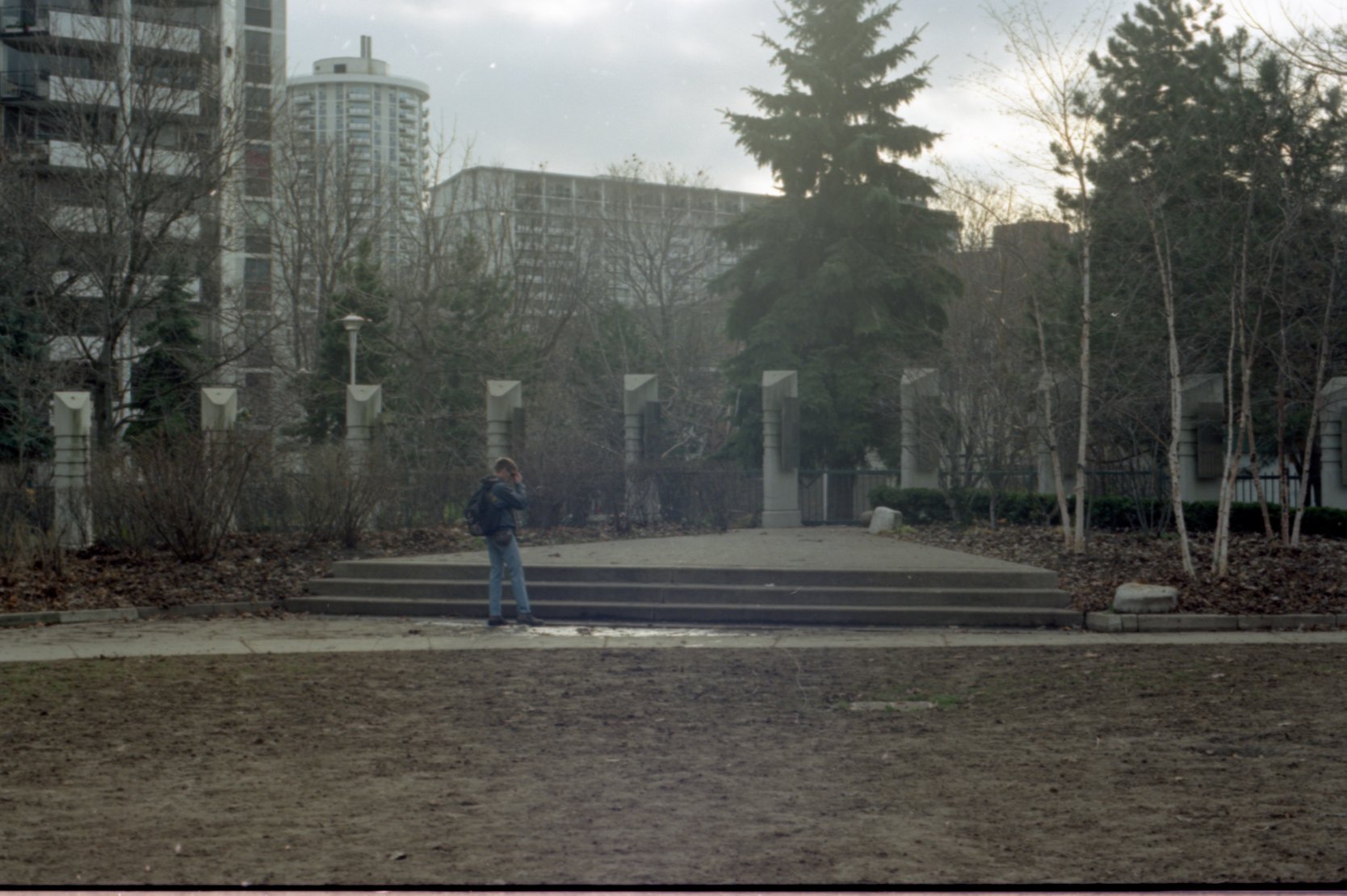
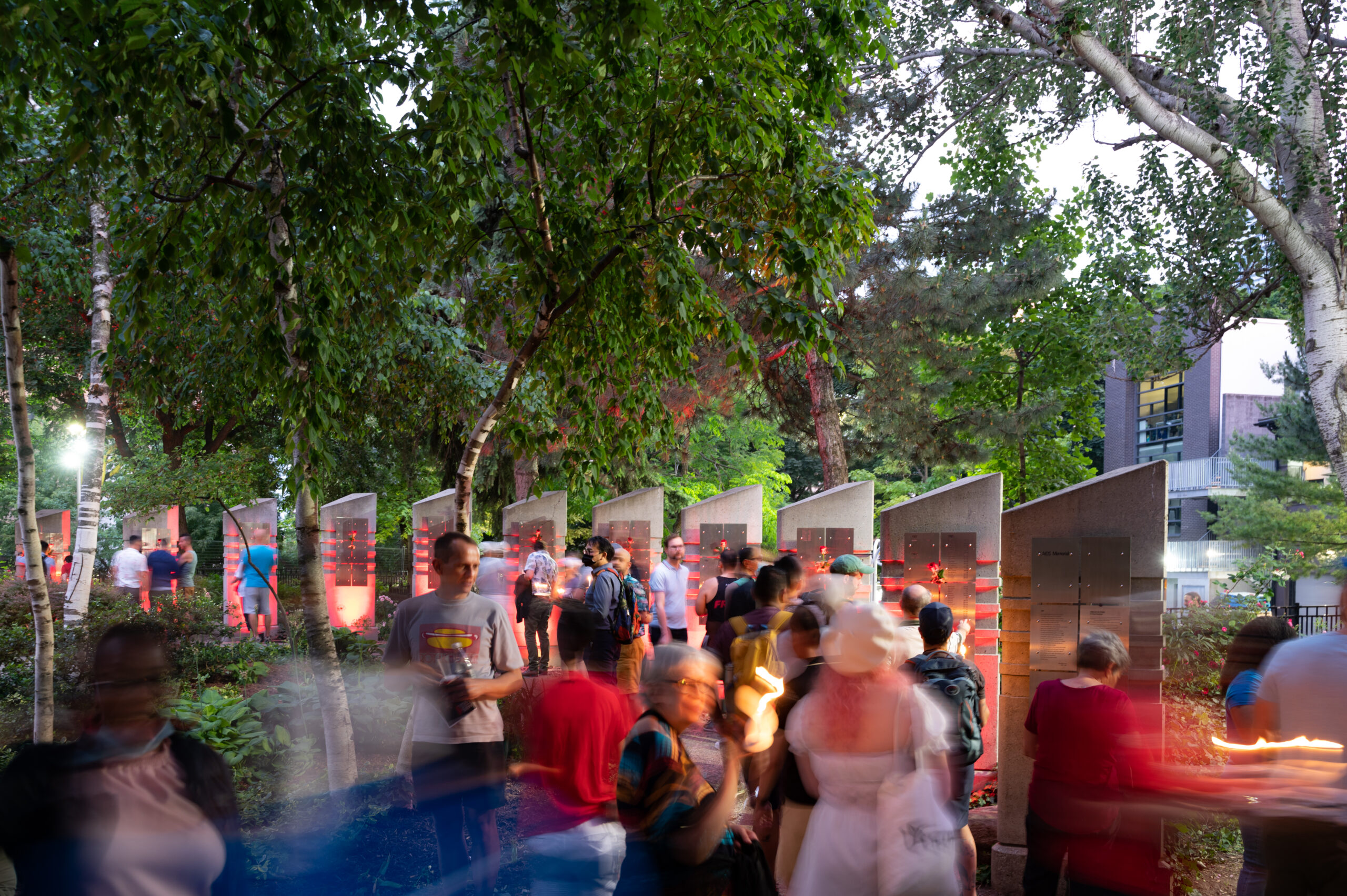
The design features cement pillars with stainless steel plaques, featuring name engravings of those who have passed away from AIDS, akin to the temporary memorials. Built with room for more names to be added, the annual tradition of the reading and adding of names to the memorial continues to this day. In 1998, due to constraints with the design, the font size of the names was reduced, with previous plaques periodically being re-engraved to account for this change (AIDSMemorial.info).

In 1995, the Universal Remembrance Plaque was added to the first pillar in the memorial to make space for those unnamed in the memorial, with the winning submission for the plaque being Shoshanna J. Addley’s poem “Circle of Stones.” Michael Lynch’s “Cry” is also ingraved on the first pillar as part of the memorialization of those named, unnamed, and Lynch himself, as he had passed away in 1991.
The AIDS Memorial Committee dissolved in the early late 90s, with the maintenance of the memorial being transferred to The 519. Continuing the AIDS Memorial Committee project, The 519 collects new name nominations annually, with new names being added to the Memorial during the Annual AIDS Candlelight Vigil in June. The AIDS Memorial currently lists over 2,900 names. The memorial remains a site for powerful remembrance of those who lost their lives due to AIDS related illnesses, and to think about the persecution, ignorance, community organizing, and love present within 2SLGBTQ+ history in Canada.
Researched and written by The ArQuives